
The reason nobody publishes screen prices is that it makes quotes comparable, and comparable quotes compress margins. We publish them anyway, because the alternative is a market where homeowners have no way to tell a fair number from a padded one.
The short answer
| Item | Detail |
|---|---|
| Single wall panel | $35 – $65 |
| Roof or gable panel | $55 – $95 |
| Full cage, one story | $1,100 – $2,000 |
| Full cage, two story | $1,900 – $3,400 |
| Florida Glass kick plate | $70 – $130 each |
| Pet mesh upgrade | +$1.75 – $3.25 per sq ft |
Those are Wesley Chapel-area numbers as of mid-2026 for a competent job using UV-stable mesh and new spline. If you are quoted meaningfully below the bottom of those ranges, something is being left out, and the rest of this article is about identifying what.
Why Wesley Chapel quotes skew toward the higher end
Two-story pool cages are close to the default configuration in Meadow Pointe, Seven Oaks and the newer phases of Watergrass, and enclosures with thirty or more panels are common rather than exceptional. That means the average Wesley Chapel quote lands higher on these ranges than the average quote in an older, smaller-cage neighborhood — not because pricing per panel is different, but because the jobs themselves are bigger.
The five things that actually move the price
1. Panel count, not square footage
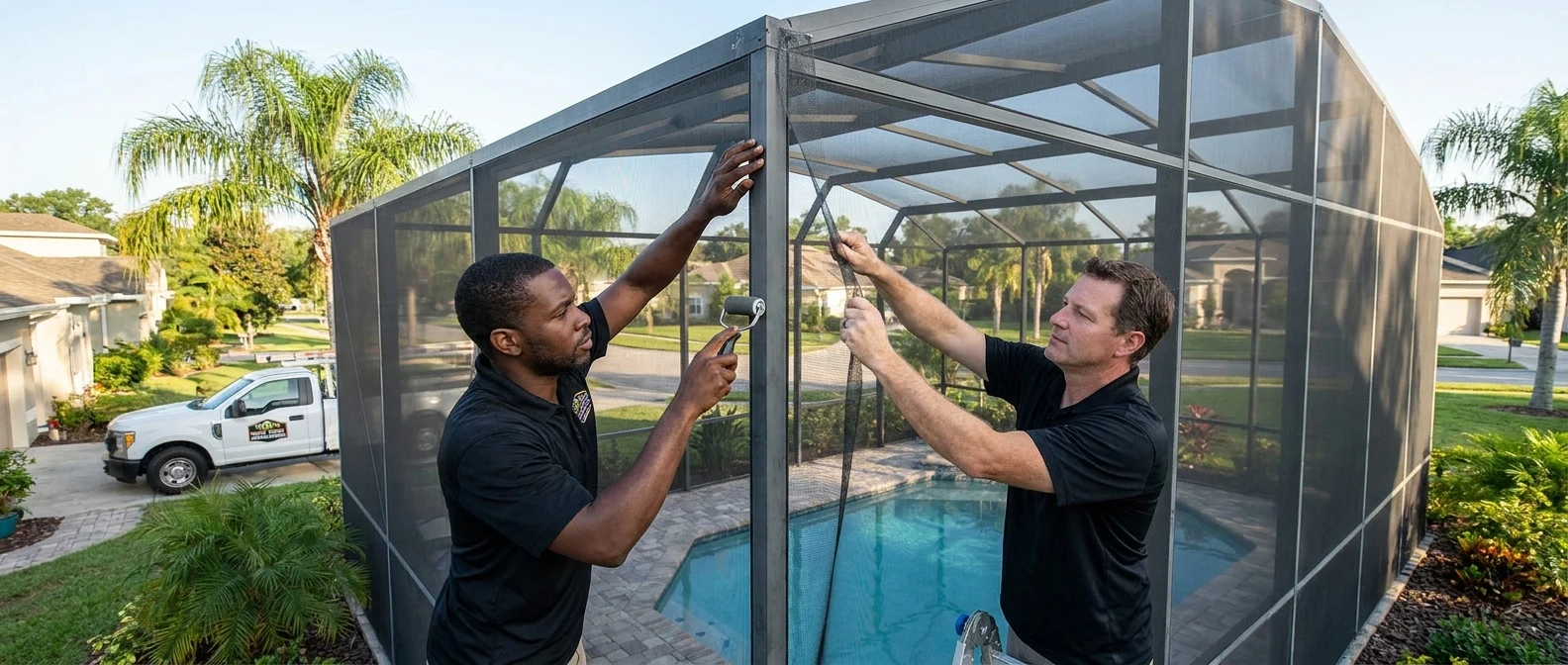
Rescreening is priced per opening rather than per square foot, because the labour is in the cutting, splining and tensioning of each panel rather than in the mesh itself. A cage with eighteen large panels costs less to rescreen than one with thirty small panels covering the same area. Count your panels before you call and you will understand your own quote considerably better.
2. Height and access
This is the single biggest jump in the pricing, and it is the main reason Wesley Chapel jobs trend larger. A two-story cage costs roughly seventy percent more than a single-story one with a similar panel count, because everything above the first level requires ladders or staging, takes longer, and carries more risk. Roof panels on a steeply pitched cage are the most expensive openings on the structure.
3. Mesh grade
Standard charcoal 18×14 fiberglass is the baseline. No-see-um 20×20 adds modestly. Pet-resistant polyester adds $1.75 to $3.25 per square foot, which on a full cage can mean $600 to $1,400. Florida Glass is priced per panel. Choosing mesh selectively rather than uniformly is the easiest way to control this line.
4. Frame condition
Frame problems are less common on Wesley Chapel’s mostly-new construction than in older Tampa-area neighborhoods, but they still turn up — loose fasteners, an anchor that has worked partially free, the occasional original-phase home now into its second decade. That is $110 to $700 depending on what is wrong, and it is not optional — mesh tensioned into a failing frame goes slack within a season.
5. Whether the roof screens are included
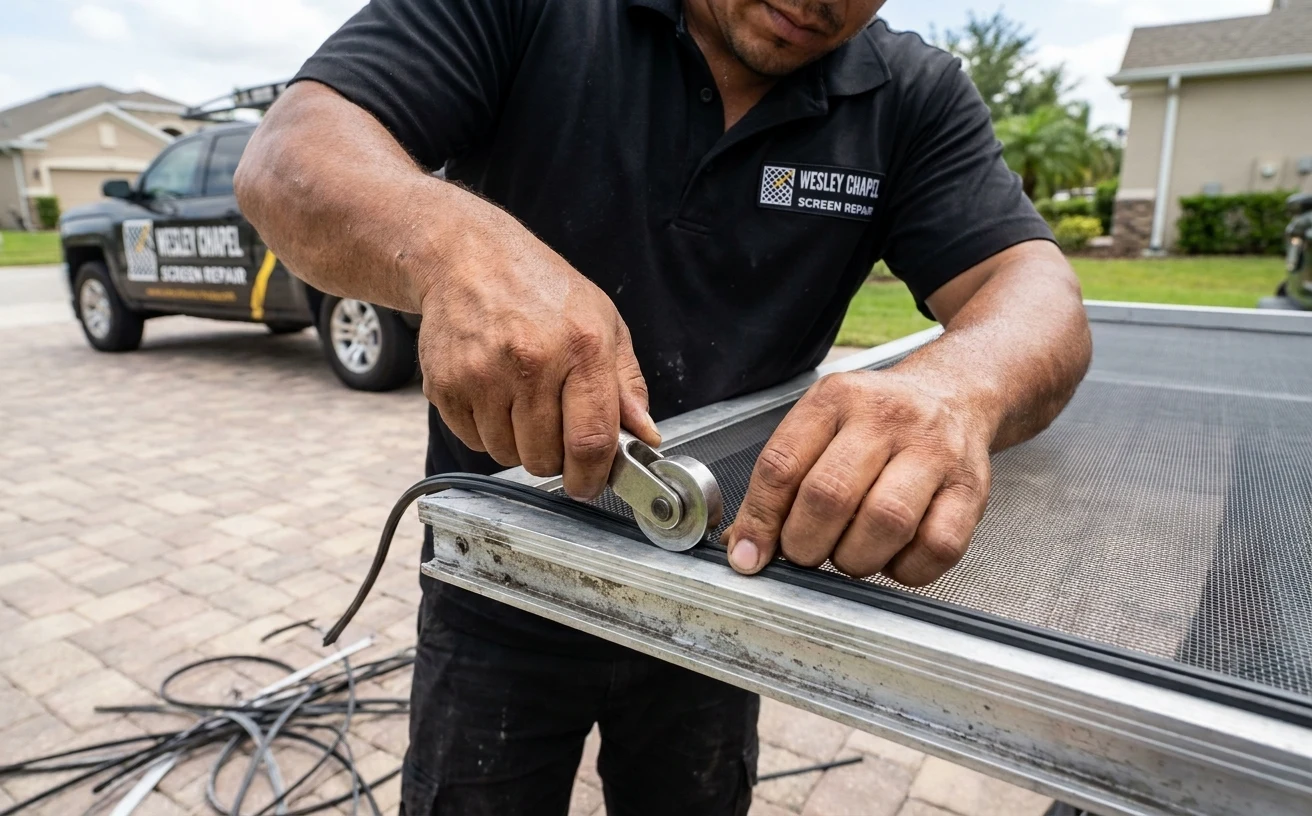
This is where cheap quotes hide. Roof and gable panels take the most direct UV on Wesley Chapel’s largely unshaded lots and fail first, and they are also the most expensive and awkward to replace. A quote that covers wall panels only can look thirty percent cheaper while leaving you with the worst panels untouched.
What a suspiciously cheap quote usually means
- Reused spline. The single most common shortcut. Old spline is dried and shrunken, so the mesh goes slack within a year. New spline costs very little and takes no extra time — reusing it is purely about speed.
- Roof panels excluded. Quietly quoting walls only, on the panels that needed it least.
- Cheaper mesh grade. Economy fiberglass rather than UV-stable, which on an unshaded Wesley Chapel lot means three years instead of six.
- Frame problems ignored. Not mentioned at the estimate, and not your problem until the panels sag.
- Mesh grain run wrong. Screen has a direction. Run it the wrong way to save cutting waste and the panel bags out in the middle within months.
Is a full rescreen or partial the better value?
Judge by the condition of the panels you were not planning to touch. If the undamaged mesh is still dark and springy, replace only what has failed. If it is grey and tears when pressed, you will be back within two years and paying mobilisation twice. On unshaded Wesley Chapel lots with little mature tree cover, the south and west walls commonly fail first, and doing those two walls now and the rest later is a legitimate way to spread cost — accepting that new mesh looks noticeably darker beside sun-faded panels.
What we would tell you on your deck
If your mesh has three or four good years left, we say so and quote only the damaged panels. If you have dogs, we recommend pet mesh on the lower rows rather than the whole cage. If the frame is the real issue, we quote frame repair first and tell you plainly that new screen on bad aluminum is money thrown away. Full pricing detail is on our pool cage rescreening page.